
Setting Goals the Easy Way in Your Business
Have you struggled with setting goals for yourself in your business? Are you not sure how to set goals, or do you struggle to see the benefit to putting time aside to setting goals?
Today I’m going to teach you why setting goals for yourself is important for your business, and an easy way to set goals that is quick and painless!
“Now, Next, Later” uses a really simple format to schedule out your goals, for either your business or for your personal life. This is a really easy way to ‘dip your toe’ into setting goals for yourself without being overwhelmed with complicated formats, set up, or devoting a ton of time. I’ll show you how you can use this technique at any level in your business or personal life.
I’ll also help you understand the value of setting goals – even if you think you understand already. I’ll also make goal setting less intimidating. It doesn’t have to be a long, complicated exercise full of woo-woo language or difficult jargon!
Why is it important to set goals?

You may think setting goals is a waste of time. That you don’t want to take time away from ‘doing the work’ to make a plan. You’re only one person, how much planning and goal setting do you need?
That, unfortunately, is the wrong way to look at it. Taking the time to set goals isn’t about ‘wasting time’ or stepping away from ‘doing actual work’.
By making sure you have goals defined for your business, you know that every single thing you work on is important and provides value. You know that you’ve taken the time to make a plan, and that the work you’re doing is all in service of your audience.
It’s simple. Goals help prevent you from spinning your wheels.
Additionally, knowing the goal you’re reaching for will then tell you when you’ve achieved it.
How do you know you’ve achieved something if you didn’t define it in the first place?
The feeling of accomplishment and satisfaction we get when we achieve our goals helps keep our momentum moving forward. It helps us keep winning. If we don’t acknowledge the wins, that little voice in our heads get louder. It keeps telling us that we’re not good enough; that we’re not going to accomplish anything; that we should just give up now.
Defining your goals is a great way to get that voice to shut the hell up. Because once you’ve accomplished a goal you set for yourself, that takes away ammunition from that voice.
But how do you define your goals without being overwhelmed?
I know what you’re thinking.
“Yeah, it’s all well and good to know why I should set my goals, but I still have no idea how to do it!”
Fear not, friend. That’s why I’m here.
I have a really (seriously, it couldn’t be any more simple) way of helping you set your goals.
It’s called “Now, Next, Later”.
This technique can be used at whatever level you need at that moment. I suggest starting at a high level and working your way down, but we’ll start somewhere in the middle to make it a little easier to understand.
But if you need to use it just to tackle today, that’s okay too. We’ve all been there.
The “Now, Next, Later” technique helps you look at your list of things to do and whittle it down. It creates focus on the most important thing at this moment.
Make a List
Grab a marker and a pile of stickie notes. A marker works best because it’s easy to read it from far away.
I actually use a free digital tool for this called Mural. I started using it to help my remote teams collaborate in a similar way to being in a room with a dry erase board and stickie notes, but now I use it all the time just for me in my business.
But if you like the feel of the marker and stickie notes in your hands, real-world physical organization works just fine too! You do you.
Take the stickie notes and just start writing down all the things you want to do. Try to keep them at generally the same level of detail.
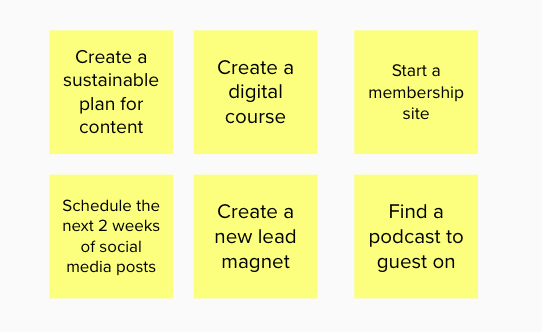
For example, in my business I would write down:
- Create a sustainable plan for content
- Create a digital course
- Schedule the next 2 weeks of social media posts
- Create a new lead magnet
- Start a membership site
- Find a podcast to guest on
Break the List Down
Some of these things are huge – like creating a digital course or starting a membership site. Some of them have pretty immediate deadlines – like scheduling the next two weeks of social media posts. That is a fairly urgent need because I know the algorithms like consistency, and since right now my queue is empty, it’s something I need to focus on ASAP.
Another somewhat urgent need is creating a sustainable plan for content. I don’t want to be constantly on the brink of my content queue being empty. That’s a lot of pressure to create content on short notice, and it means the rest of my efforts won’t be cohesive.
So if I make creating a content plan a priority, that will have a huge impact.
Those factors help me decide to put these two goals into the “Now” category. They have urgency, and other, bigger goals depend on completing these first.
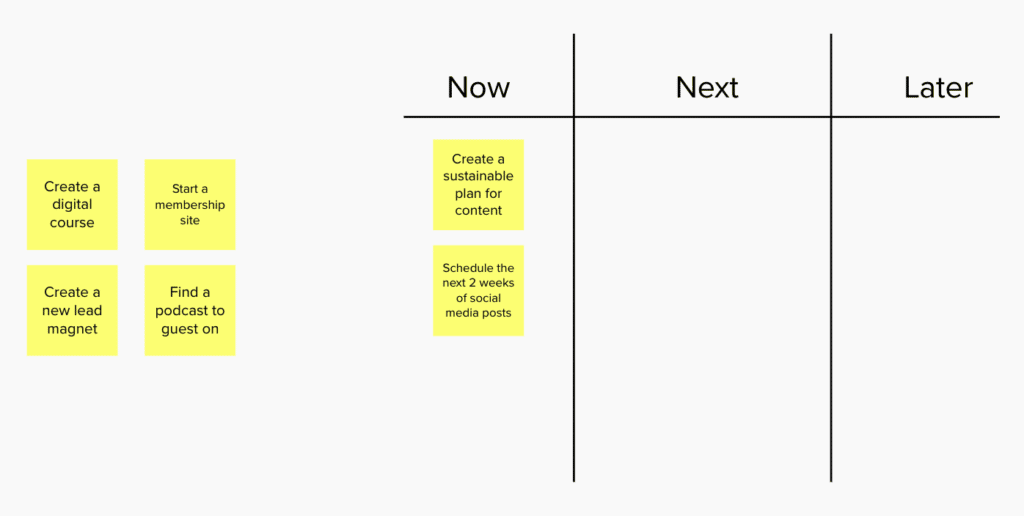
Planning for the Future
The bigger things – like creating a membership site or digital course – are important, of course, but they don’t have the same urgency. It’s important for me to know what my content is going to be to have a better understanding of what value I can provide through a digital course or membership site.
So because those things are huge and nebulous, and dependent on the other pieces, they go in the “Later” category. They’re goals I want to keep in mind to work towards, but not things I can action right now, or even in the near future.
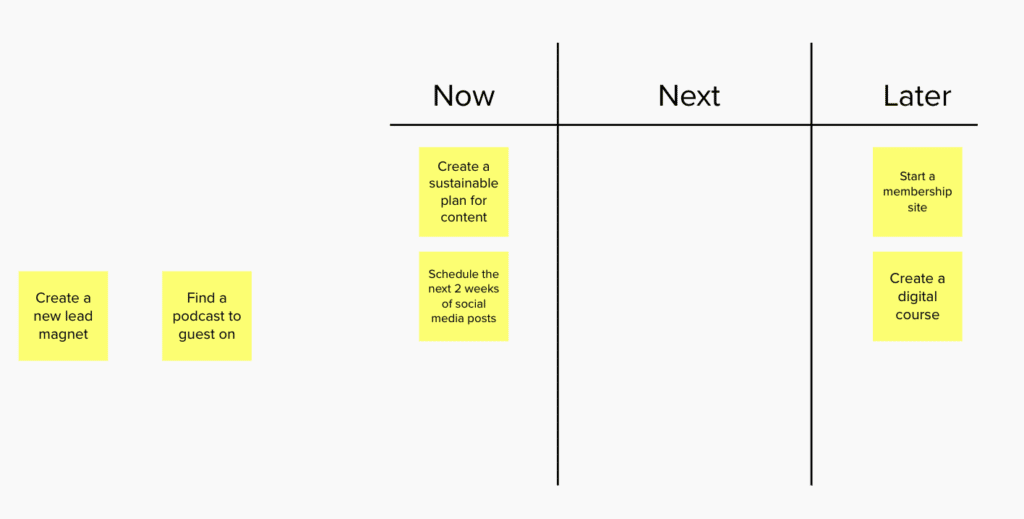
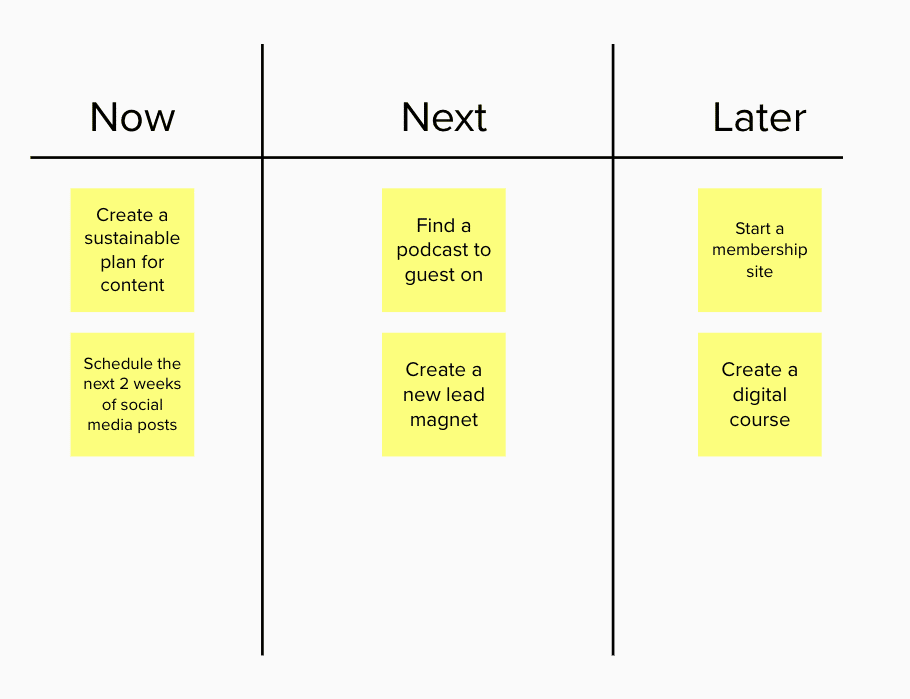
That leaves two more goals – create a lead magnet and find a podcast to guest on. These goals aren’t huge chunks of work like the “Later” goals. They do require more effort than the “Now” goals, though.
But they’re still dependent on the two items already in the “Now” goals – I need to have my social media running on autopilot and I need to understand what my content strategy is to create an effective lead magnet and to start to research podcasts.
Now my “Now, Next, Later” goals are in place, I’ve finished setting my goals.
Setting Higher-Level Goals
These goals I’ve used as an example are all very hands-on, on-the-ground, tactical goals. The “Now, Next, Later” technique is great for just getting your arms around all the stuff warring for space in your head. And using it at this level is great for getting an understanding and a feel for how this method works.
But what if you want to dream bigger?
I’m always an advocate for setting big, difficult-but-possible goals for your business. I think having an overarching understanding of why you’re doing what you’re doing is the key to success.
Fortunately this method, even though it’s simple, is really useful for getting those goals organized.
Let’s say you’re a life coach. Your business has been going for awhile and while it’s going well, it’s not going great. You feel like you’re busy all the time, but at the end of the day you don’t really know what you accomplished.
You have no idea if you’re moving the needle forward. Because you don’t really know where you want to go.
You can take this exact method that we used for our tactical work above and apply it to your strategy as well.
Strategic Goal Setting
Sit down and brainstorm all the things you want to accomplish in your business. I don’t mean those little tactical things we talked about earlier.

I mean BIG.
You want to gain enough clients to need to hire additional coaches.
Create enough passive income not to have to work 40-60 hours a week.
Build your business up to sell it for seven figures.
These are all really, really big goals. And that’s exactly what you should be striving for here – BIG, strategic goals.
You’ll notice that none of the examples I gave list specific monetary goals. And that was intentional.
I always recommend my clients not focus on output and instead focus on outcomes. You may have to reach specific objectives to get there, but the focus should always be on the outcome.
What makes outcomes different from output?
In the words of Harvard Business Review:
Let’s define outputs as the stuff we produce, be it physical or virtual, for a specific type of customer—say, car seats for babies. And let’s define outcomes as the difference our stuff makes—keeping your child safe in the car… Outcomes are the difference made by the outputs…Outcomes are the benefit your customers receive from your stuff.
Harvard Business Review
So your big, high-level goals should be defined as the outcomes of your work. While Harvard Business Review defines outcomes in terms of the benefits to your customer, I think you can also talk about them in relation to your life and well-being. Chances are, providing value to your customers will be a crucial piece of creating the outcomes you want for yourself.
Define your outcomes
Now that you understand what outcomes are, take a few minutes with your trusty stickie notes and marker and write down what you want the outcomes of your work to be. They can be customer- or you- focused. Make them big and challenging but not totally impossible.
Set a timer for 10 minutes and just let the words flow.
Don’t censor yourself or edit what you want – be honest. Yes, we build businesses to serve others because we know we have skills that they can benefit from, but we also need to be true to ourselves and what we need for our own well-being.
After the 10 minutes is up, take a look at what you’ve written. See if you can group like-items together, if two or more stickies are close enough.
Once you have your stickies narrowed down:
- Pick out 2-3 goals that seem like ‘low hanging fruit’, or the easiest to accomplish relatively quickly. Are they still important to you? Do they represent what you want to focus on first? Pick the most important one of these (what will give your customers the most value?) and put it in your “Now” column.
- Now pick 2-3 different goals that seem somewhat challenging. You know they’ll require a lot of work, but you have the skills, knowledge, or resources to accomplish them already. Pick the most valuable of these (for you or your customers) and put it in the “Now” column.
- What you should have left are the big, scary, really difficult goals. Which one scares you the most? Which one is the most intimidating? Put that in the “Now” column. Because if you put that big, scary goal off – you’ll never be brave enough to tackle it.
- Divide the remaining goals into “Next” and “Later”. I suggest taking value provided into account – but you can also consider how easy or difficult something is. Sometimes you need an easy win to keep going.
There. Now you have the big goals for your business, organized by how important they are and when you’re going to focus on them.
Ongoing Goal Setting

Make a plan to review your goals regularly.
For your big, high-level business outcomes, I would revisit these at least once a quarter. They’ll help you define what you should focus on for the next quarter, and you can reset based on how last quarter went.
You can use this technique for planning out your day as well – define what you want to accomplish, then figure out what level of priority each task is. Then repeat the activity every morning – or at the end of every day for the next day, if you’re that organized (I am not).
This technique may seem super simple (and that’s because it is), but I’ve used it countless times with teams and within my own business.
In fact, this blog post is a result of me planning using this technique.
You saw above a simplified version of the planning I use in my business to figure out what to focus on in the near-term. I’ve heard from so many entrepreneurs and business leaders that they feel like they spin their wheels and nothing gets accomplished and at the end of the day, they have nothing to show for all the work they put in.
Setting goals this way helps you to see the bigger picture. If you have a team, it’s even more important so everyone understands the direction they’re moving in. Once everyone understands where they’re headed, they can work together to figure out the best way to get there.
Wrap Up
I hope this technique is helpful for you in your business. Or even just your personal life. Sometimes you just need to take a step back, do a brain dump of all the things, and make a plan. This method is a super simple, easy, and quick way to get it all organized and get you back to ‘doing all the things’.
Start Your CEO Journey: The Efficiency Advantage
Discover the 5 key shifts successful business owners make to stop doing everything themselves and finally step into true CEO mode.
Hey! I'm Lauren -

Hey! I'm Lauren -
World traveler, jigsaw puzzle enthusiast, and Productivity Coach.
I help business owners take back control of their time so they can focus on what actually moves their business forward.
With a background coaching product teams at brands like Apple, Whole Foods, and the federal government, I know how to cut through the chaos and create strategies that make work easier without forcing you into rigid systems.
I’ve been in the online business space since 2014, starting with blogging, Pinterest management, and other projects. Those early experiences gave me a deep understanding of how online businesses work.
While I began as a leadership coach, I quickly realized my real passion is helping entrepreneurs master their time so they can spend less of it spinning their wheels and more of it doing the work that actually matters.
Now, I help business owners get more done in less time—not by cramming more into their schedule, but by teaching them how to work smarter.
Whether you want to clear the mental clutter, get unstuck, or finally follow through on the plans you keep making, I’ll help you create a productivity strategy that fits you.


EXPLORE
Lauren Glynn Consulting is where successful women and nonbinary business owners come when they're ready to stop being the bottleneck and start leading their business. Through customized operational leadership coaching and done-with-you systems implementation, I help you build the leadership capacity AND the operational infrastructure to step out of the day-to-day and run a business that doesn't need you holding everything together.
Copyright 2026 Lauren Glynn Consulting LLC. All rights reserved.