
Focus on Customer Value When Prioritizing Work
What is the best way to prioritize work? The answer may seem obvious: the tasks that are most important should be completed first. But not all tasks are created equal. Some take more time and effort than others, some require a high level of skill, and some must be completed before other tasks can move forward.

In order to truly understand what needs to get done first, you need to focus on customer value. This means understanding who will benefit from the work being done and how it will affect them positively or negatively. It also means knowing where you want your product or service to go in terms of quality and which direction is easier for customers — short-term or long-term — so that you can evaluate how difficult each task is based on how much needs to be done.
When prioritizing work, understand what you want that value to be in the long-term, and find a path that gets there via smaller steps while still being confident that each step taken is moving in the right direction. This will ensure an effective strategy for producing a product that your customer wants based on customer value while mitigating the risk of wasted effort.
Define Your Product Vision
Before you can begin to prioritize, you need to define your product vision. This means identifying what your customers want or need, how it will make their life better or easier, and why they should buy from you instead of a competitor. It also means taking a step back and looking at the big picture. Don’t be distracted by individual tasks that may seem urgent at the moment but don’t serve the overall goal of growing your business. Remind yourself of your vision and why it matters by thinking about what you want your product to do for the people who use it. Your vision should unify your product and everyone who works on it so you’re all working towards the same goal.
In creating your Product Vision, you should be focusing on customer value. What need does your product, project, or service fill for your customers? What’s most important to them? Why is your product a better option than others?
Even if you’ve been working on your project or product for a while already, it’s still important to define a product vision. And it should be revisited regularly to ensure it still aligns with the need you want to serve for your customers.
How to Define Your Product Vision with a Focus on Customer Value
There are innumerable ways to create and define your Product Vision. For teams I work with, I like to use a Product Vision statement.
“For (target customer) who (customer’s need), the (product) that (key benefit/reason to use). Unlike (primary competitive alternative), our product (statement of differentiation).”
To build out this statement, we have a brainstorming session. I created a Mural template to facilitate this process, but you can do it however works for you and your team.
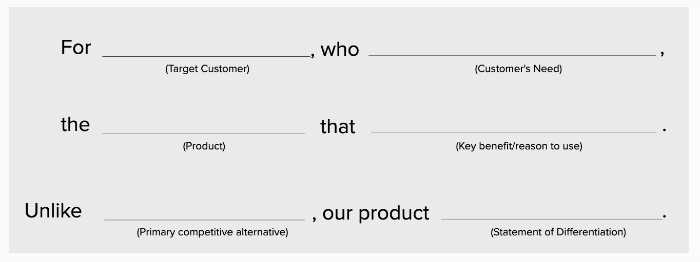
In the session, we have a 5-minute timebox for each section we’re working to fill out. At the end of 5 minutes, we’ll discuss as a group and come to a consensus. Then we move on to the next section. At the end, we add all the results from each section to the full statement, and then workshop it to make sure it makes sense. We keep the focus on customer value throughout the entire process.
The Product Vision Statement becomes the foundation of the product, so it’s important it aligns with why your product exists and that everyone is in agreement. When working with teams, I always reference the Product Vision Statement whenever we work on defining and prioritizing work. It should be the guiding star of your product and everything you do should work towards it.
Identify your Objectives and Key Results

Now that you have your Product Vision Statement defined, it’s time to break it down.
Objectives and key results, or OKR’s, were invented by a man at Intel named Andy Grove in the 1970’s. They’ve since been adopted by thousands of companies – from Google to Netflix to Allbirds – and some people even use them in their personal lives.
They help you put nebulous ideas into concrete, actionable plans. OKR’s define not only what your goal is, but exactly how you will achieve it. And they should also have a laser focus on customer value.
An objective is what you intend to be achieved. Simple and straightforward. They are intentionally simple and straightforward and action-oriented. Hopefully they’re even a little inspirational.
A key result is an action-oriented goal or benchmark that will help achieve the objective. They generally use the SMART goal structure:
Specific – the goal is clearly defined
Measurable – success can be measured in whether or not the result is achieved
Achievable – it’s a realistic, though hopefully aggressive, goal
Relevant – it aligns with the mission of the objective
Time-bound – it must be completed in a specified time frame usually a quarter.
OKR’s define what you want to accomplish, and how you expect to do it.
Example of Objectives and Key Results
Let’s say your company wants to reach more customers that need your product by increasing sales on your website. That would be the objective. Then you would break that objective down into the pieces you’d need to achieve that goal.
In the next quarter:

You have an objective, and measurable, actionable, aggressive key results. The key results are specific, measurable, relevant, and time-bound. They have a focus on customer value. Now your team can plan their work around meeting these key results in the next quarter.

I recommend starting with just a few OKR’s to begin with, especially if your company is small. For a larger company, you may have OKR’s at multiple levels – across departments, across teams – so it may make sense to have even one level above OKR’s, Strategic Themes.
OKR’s can be defined by leadership, or it can be a collaborative process with your leadership and team members, depending on your org structure. Each OKR should also have an owner defined. Again, if your company is small, it may just be you, the owner. If your company consists of multiple teams and levels of management, there may be many layers.
Prioritization with a Focus on Customer Value
Now that the OKR’s are defined, it’s time to make the work something the team can actually do.
First, the OKR’s and Key Results should be prioritized. That will help guide the team in how they break down the work.
When prioritizing, ask yourself, “Which of these Key Results is most beneficial to the customer?” “What’s the level of effort or difficulty?”
One technique you could use to prioritize would be the MoSCoW approach. Sort your OKR’s into these categories:
Must Have – These are non-negotiable and must be included.
Should Have – These are important, but not as important as the Must Have’s, and aren’t a necessity
Could Have – If there’s time and space available, these are next to be included in the work to be done
Won’t Have (or Wish for) – These are the first to be dropped if the team runs out of time or resources and generally are assumed not to be included.

Now the team has an idea of the most important thing to focus on first (Must Have). This is what they should also focus on breaking down first.
Prioritization at this stage should be very high level so it can be used as a guideline for the rest of the work.
Breaking it Down to Manageable Chunks
When I work with companies, I recommend taking the next level down to the team level, if you haven’t already. The teams will have the most knowledge about how to accomplish the key result. They should be involved in defining the work at this level.
Brainstorm with the team what the Objectives and Key Results are. I even recommend sharing all the OKR’s, even if it doesn’t seem relevant to that team. The more of the big picture the team has access to, the better their decisions will be.
Story Mapping with a Focus on Customer Value
With my teams, I do an activity called Story Mapping. In Story Mapping, teams take the overarching Key Result and break it down into smaller, actionable steps. There may even need to be an interim level, depending on how big your company is and how big the Key Results are. This is also a big help in aligning teams around shared values, especially if they’re remote.
In Story Mapping, teams literally map out the work. At this point it can still be pretty high-level, it doesn’t need to be down to the nitty-gritty step-by-step details, but it should be an outline of the work needed to be done, both so that the team can have an idea of the relative level of effort it will take and so that it can be prioritized.
In another Mural template I’ve created, the whole Product is pulled together. From the Product Vision Statement created earlier, to the full list of OKR’s, down to the breakdown of the work.

This helps the team to see the full picture (because you’re practicing intent-based leadership, right?). It also helps to see the hierarchy and the product foundation. From there, work with the team to break down each Key Result into Features, and then into Stories. If your work isn’t that involved, you could skip the feature level and go right to stories that roll up directly to the Key Result. It just depends on how your individual team functions.
Telling Stories
A story is a manageable, bite-sized piece of work. The general guideline is a story should take two weeks or less to complete. If it’s bigger than that, break it down until each piece is about that size or smaller.
The reason for this is to get visibility into the work being done and the progress being made. If the work wasn’t broken down and was just this big nebulous blob of “here’s where we’re aiming for”, it’s incredibly difficult to understand how much progress has been made and how much is left to go.

The Story Mapping process makes it easy to see the work as a whole. It also makes the individual tasks and steps involved visible. It also creates a throughline from the work one person is focusing on all the way up to the OKR it derives from. That helps employees feel like their work is important; that it matters in the big picture of the company. It also helps them to focus on customer value while doing their work.
Taking Level of Effort into Account
Now that the Most Important Key Results are broken down for your Most Important Objectives, it might be a good time to double-check your prioritization. Is your most important objective also your most difficult? That’s not necessarily a problem, but if the necessity of your Should Have item is almost-as important as the Must Have item but is multitudes easier, it might be worth considering swapping the two.
It may also be worth keeping the difficult Must Have if it’s really that important instead. But it’s worth at least the consideration.
Building a Work Runway
Now that the work is broken down into manageable chunks (Stories), it’s time to start making a plan.
The team should start now listing each individual Story in priority order. This will result in one list of work items (for each team) in the order of which they need to be completed. They can use the MoSCoW method again, or a different method. Or they can just talk it out.
Whichever method they choose, it should be done in collaboration with the OKR owner. They understand how best to focus on customer value, and the team understands the methods and dependencies required for the work to be done, so it’s imperative that both are part of the conversation.
This list should live somewhere. There are innumerable project management software options that can support this way of working – Jira, Trello, Asana, Monday.com, Clickup – and each function slightly differently and may or may not be the right fit for your company and team, depending on your needs.
Continuous Improvement

Not only should the list live somewhere easily manageable and accessible by the team, but it should also be a living, breathing thing. The list of prioritized work should be constantly refined, discussed, re-prioritized, and culled.
Leadership should review their OKR’s at least quarterly to determine if the Objectives have been met. They should also review if the OKR’s are still relevant, and determine what new Key Results should be focused on.
Teams should meet regularly (every 1-2 weeks) to review the list of work with the OKR owner to make sure they are still focusing on the highest-priority, most valuable items. This is also the team’s opportunity to ask questions or get clarification on anything.
Putting it All Together
Now you have all the pieces and tools you need to build your prioritized list of work with a focus on customer value. If this is feeling overwhelming to you, don’t worry. Take a deep breath and take it one step at a time. You don’t need to complete all the steps in one session or even several sessions.
It may take trial and error to figure out the pieces that work for you and your team. That’s okay.
Experimentation is how we improve. In the words of Mythbusters, “Failure is always an option.”

Works Cited

Start Your CEO Journey: The Efficiency Advantage
Discover the 5 key shifts successful business owners make to stop doing everything themselves and finally step into true CEO mode.
Hey! I'm Lauren -

Hey! I'm Lauren -
World traveler, jigsaw puzzle enthusiast, and Productivity Coach.
I help business owners take back control of their time so they can focus on what actually moves their business forward.
With a background coaching product teams at brands like Apple, Whole Foods, and the federal government, I know how to cut through the chaos and create strategies that make work easier without forcing you into rigid systems.
I’ve been in the online business space since 2014, starting with blogging, Pinterest management, and other projects. Those early experiences gave me a deep understanding of how online businesses work.
While I began as a leadership coach, I quickly realized my real passion is helping entrepreneurs master their time so they can spend less of it spinning their wheels and more of it doing the work that actually matters.
Now, I help business owners get more done in less time—not by cramming more into their schedule, but by teaching them how to work smarter.
Whether you want to clear the mental clutter, get unstuck, or finally follow through on the plans you keep making, I’ll help you create a productivity strategy that fits you.


EXPLORE
Lauren Glynn Consulting is where successful women and nonbinary business owners come when they're ready to stop being the bottleneck and start leading their business. Through customized operational leadership coaching and done-with-you systems implementation, I help you build the leadership capacity AND the operational infrastructure to step out of the day-to-day and run a business that doesn't need you holding everything together.
Copyright 2026 Lauren Glynn Consulting LLC. All rights reserved.