
Defining Your Team’s Work: Why Understanding Customer Value Matters
For a team to be successful, they must understand the work that needs to be done. This starts by understanding customer value and then organizing and prioritizing that work. In this blog post, we will discuss the importance of customer value and how it can help your team be more productive and efficient. Additionally, we’ll supply some tips for leadership to help teams prioritize their work.
Why Customer Value is Important

Prioritizing work based on customer feedback is essential to keeping the team’s attention on the most critical tasks at hand. It helps teams understand the needs and wants of their customers, which in turn helps them focus their efforts on tasks that will provide the most benefit to customers. This means that teams can ensure they are working on projects and tasks that will drive business success.
By focusing on customer value, teams understand what work needs to be done, how it should be prioritized, and how they can best serve their customers. Teams can focus on the tasks that will provide the most benefit to customers and help drive business success.
When it comes to prioritizing work based on customer value, leadership has an important role in setting expectations and making sure everyone understands why specific tasks are being given priority over others. Leaders need to ensure that all team members have a clear understanding of the goals of each project or task, so they know why certain things are more important than others.
They also need to set deadlines for projects and tasks so that everyone knows when something needs to be completed for it to remain valuable for customers. Additionally, leaders should emphasize communication between team members so that nothing gets lost in translation along the way.
How to Define Customer Value
Teams should create ways to hear directly from customers for them to have direct input into planning future work.
For example, many online apps have their roadmap visible on their website. This allows them to provide a way for customers to vote for the features that matter most to them. On the website for the app ClickUp, they list all the feature requests from customers, and logged-in users can upvote and comment on the ones they think would be most useful.
Companies could also look at any complaints they receive from customers – are there any trends or common topics that surface frequently?
If building a visible roadmap isn’t feasible, teams or companies can also reach out to customers directly with simple surveys (if they get too complicated, customers are unlikely to take the time to respond). Three to five questions about how a customer might like to use a product or what frustrates them can go a long way in informing where the team should go next.
How to Prioritize Work Based on Customer Feedback
Once a team has received feedback from their customers, they need to decide how to interpret that information and translate it into a plan of action.
There are several different prioritization techniques. Here are a few to consider:
MoSCoW
Must Have
Should Have
Could Have
Won’t Have
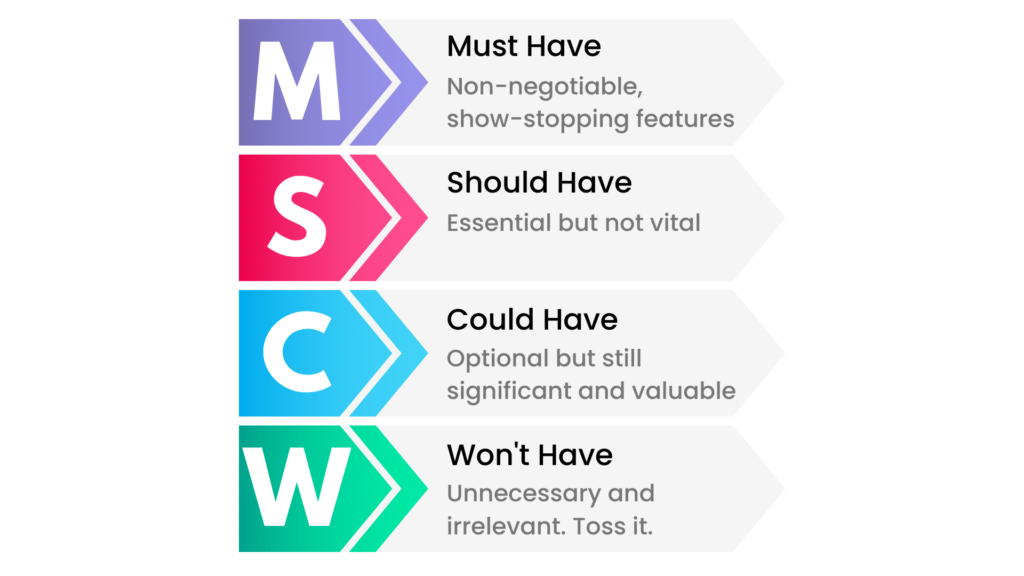
Must have: These are features without which the product won’t operate or won’t meet the requirements. These features are show-stoppers.
Should have: These are important features that should be included if at all possible, but aren’t showstoppers.
Could have: These are nice-to-have features that would provide additional value or benefit if time and budget allow.
Won’t have: These features will not be included in the current scope or timeframe.
RICE
The RICE prioritization technique can be used when teams are looking to prioritize tasks based on customer feedback. It stands for Reach, Impact, Confidence, and Effort. Teams use this method to evaluate the expected return of each feature relative to the amount of effort needed to implement it.
Reach: This measures how many users the proposed feature would impact. It’s useful for teams that want to make sure they’re targeting features that will benefit the largest number of customers.
Impact: This determines how much value each proposed feature brings in terms of time savings or improved user experience. The higher the impact, the more important a task may be in terms of customer value.
Confidence: This assesses how certain a team is that a proposed feature will have a desired outcome. Teams should be realistic about their estimates and factor in any potential risks associated with implementing the feature.
Effort: This is a measure of how long it will take for a team to complete a project or task. The total effort required should be taken into account when determining which projects should take priority over others.
Teams can decide on a scoring scale and assign each category a value for a particular feature. They then can use those scores to prioritize across features.
Using the RICE prioritization technique can help teams focus their efforts on projects and tasks that are most likely to provide value for customers and drive business success. By evaluating potential tasks based on reach, impact, confidence, and effort, teams can ensure they are making decisions that align with customer needs while also taking into account their own resources and capabilities.
Eisenhower Matrix
The Eisenhower Matrix is a popular prioritization technique based on Dwight D. Eisenhower’s decision-making process, which he used to determine how he could best allocate his time.
The Eisenhower Matrix divides tasks into four categories: urgent and important; not urgent but important; urgent but not important; and neither urgent nor important. Urgent tasks are those that need to be completed immediately, while important tasks are those that will have an impact on the team’s long-term goals.

Tasks that fall into the “urgent and important” category should be tackled first because they require immediate attention and will have a direct impact on the customer. These are tasks that should be done as soon as possible to stay on track with projects and maintain momentum.
Tasks in the “not urgent but important” category should also be given high priority. They align with long-term goals, even if they don’t require immediate attention. These tasks may include activities such as planning for future projects or setting up processes for efficient operations. Focusing on these tasks can help create a solid foundation for future success.
Tasks that are both “urgent but not important” should be delegated or outsourced whenever possible. These tasks may include responding to emails, attending meetings, or dealing with other day-to-day administrative work. This work won’t move the needle significantly when it comes to achieving long-term goals.
Finally, tasks in the “neither urgent nor important” category can usually be dropped altogether. They won’t have any significant impact on outcomes regardless of whether they’re completed or not. Teams should avoid getting caught up in this type of task if at all possible. This allows them to focus their energy on more meaningful endeavors instead of wasting valuable time on things that don’t make a difference in the end result.
How does leadership fit in?

Leadership must provide the support the team needs for prioritizing work without micromanaging. Teams should be free to prioritize tasks and activities in a way that makes sense based on customer feedback.
Leadership can provide guidance on how to assess the importance of each feature, but should not dictate.
Remember:
The people closest to the work have the best information for making decisions on what work gets completed and how to do it.
Leadership should also strive to create an environment where teams feel confident making decisions and taking risks. Teams should not be afraid to fail. Failure may lead to learning new things that can help them in the future.
Finally, leadership must remain flexible and open-minded when it comes to changing priorities. Things change quickly in today’s business landscape, so leaders must be ready to adjust accordingly if needed.
Let’s see some examples
Airbnb
One example of a team successfully understanding their customer’s needs and prioritizing their work accordingly is the engineering team at Airbnb.
The company was already successful. But it knew that it needed to stay ahead of the competition by developing new features quickly.
To do this, their engineering team relied heavily on customer feedback. They used it to determine which features would give customers the most value in the shortest amount of time.
This allowed them to focus on high-priority tasks while also allowing for room to experiment with potential features that could help improve customer experience.
As a result, Airbnb has continued to be one of the leading providers in the travel industry. By understanding what provides value for its customers, it was able to focus on the tasks that made the biggest impact.
Netflix

Another example of a successful team is the engineering team at Netflix. They had to focus on how it can innovate quickly to remain competitive in a changing landscape.
In response, they developed innovative tools and algorithms to process customer feedback more efficiently and translate it into actionable tasks. This enabled the team to prioritize tasks based on customer feedback. This also allowed room for experimentation with new features or products.
By prioritizing tasks based on what provides value to its customers, Netflix has been able to maintain its position as one of the top streaming services in the world.
These examples demonstrate that understanding what provides value to your customers and properly prioritizing work is essential to success. Teams that prioritize customer feedback and focus on the tasks that have the biggest impact are able to remain competitive in an ever-changing landscape. By understanding what matters most to their customers, teams can ensure that their hard work leads to meaningful results.
Conclusion
I hope this discussion on how understanding what provides value to customers can help teams prioritize their work more effectively. Teams should use customer feedback to assess the importance of each task. This allows them to focus on tasks that make the biggest impact. Leadership can provide guidance on how to properly prioritize tasks, but should also stay flexible and open-minded when it comes to changing priorities as needed.
To demonstrate successful examples of this concept, we showcased Airbnb and Netflix who have used customer feedback to inform their prioritization of tasks with great results.
By understanding what matters most to your customers and focusing on high-priority tasks, teams can ensure that their hard work leads to meaningful outcomes.
Does your team struggle to define customer value? Book a free consultation call today to see how we can help!
Works Cited
1.”How Airbnb Uses Automation To Prioritize Features Based On Customer Feedback.” Built In, 22 July 2019, https://builtin.com/customer-feedback/airbnb-automation-prioritize-features
2.”How Netflix Does Engineering Right, And What You Can Learn From It” Medium, 8 Dec. 2017, https://medium.com/netflix-techblog/how-netflix-does-engineering-right-and-what-you-can-learn-from-it-fb3b596dc9c1. Accessed 5 May 2020.

Start Your CEO Journey: The Efficiency Advantage
Discover the 5 key shifts successful business owners make to stop doing everything themselves and finally step into true CEO mode.
Hey! I'm Lauren -

Hey! I'm Lauren -
World traveler, jigsaw puzzle enthusiast, and Productivity Coach.
I help business owners take back control of their time so they can focus on what actually moves their business forward.
With a background coaching product teams at brands like Apple, Whole Foods, and the federal government, I know how to cut through the chaos and create strategies that make work easier without forcing you into rigid systems.
I’ve been in the online business space since 2014, starting with blogging, Pinterest management, and other projects. Those early experiences gave me a deep understanding of how online businesses work.
While I began as a leadership coach, I quickly realized my real passion is helping entrepreneurs master their time so they can spend less of it spinning their wheels and more of it doing the work that actually matters.
Now, I help business owners get more done in less time—not by cramming more into their schedule, but by teaching them how to work smarter.
Whether you want to clear the mental clutter, get unstuck, or finally follow through on the plans you keep making, I’ll help you create a productivity strategy that fits you.


EXPLORE
Lauren Glynn Consulting is where successful women and nonbinary business owners come when they're ready to stop being the bottleneck and start leading their business. Through customized operational leadership coaching and done-with-you systems implementation, I help you build the leadership capacity AND the operational infrastructure to step out of the day-to-day and run a business that doesn't need you holding everything together.
Copyright 2026 Lauren Glynn Consulting LLC. All rights reserved.